The Utah Legislature has advanced a bill through the state Senate proposing a tax on online adult content used to fund age verification compliance and enforcement efforts and teen mental health response. The proposal now advances to the House of Representatives with amendments to the original measure.
Bill Advances with VPN Prohibition
The Utah Legislature has advanced a bill through the state Senate proposing a tax on online adult content used to fund age verification compliance and enforcement efforts and teen mental health response. The proposal now advances to the House of Representatives with amendments to the original measure.
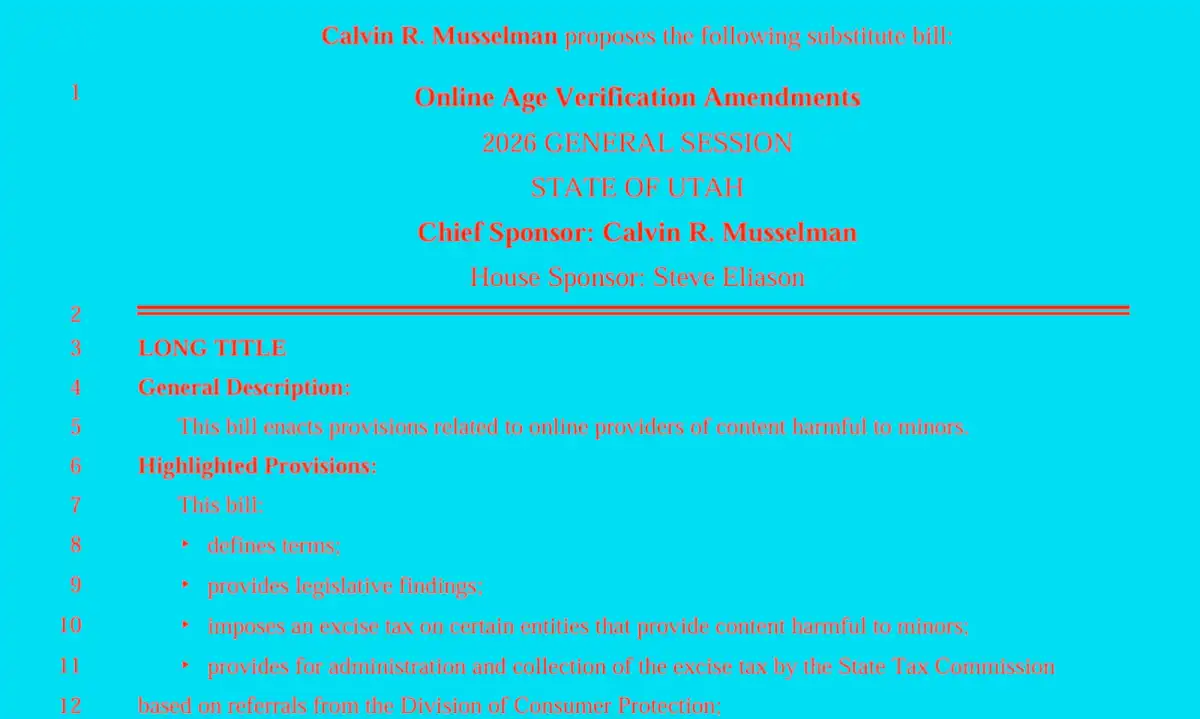
Republican state Sen. Calvin R. Musselman, hailing from the small town of West Haven, is the primary sponsor of Senate Bill (SB) 73, which proposes a "material harmful to minors tax." An original version of the bill featured a 7 percent levy on gross income from the sale of material defined as harmful to minors. Now it's 2 percent.
SB 73 is currently pending before the House Revenue and Taxation Committee, where it is likely to advance with GOP endorsement.
VPN Prohibition
The bill also prohibits the use of virtual private networks (VPNs) to circumvent laws related to age verification. The addition of VPNs to the proposal is characteristic of a Republican legislative trend to restrict or ban the use of proxy tech.
"An individual is considered to be accessing the website from this state if the individual is actually located in the state, regardless of whether the individual is using a virtual private network, proxy server, or other means to disguise or misrepresent the individual's geographic location to make it appear that the individual is accessing a website from a location outside this state," the bill now states.
Background and Criticism
The Utah Legislature has been working on age verification laws for online adult content. In 2023, the state passed a law requiring adult content websites to verify the ages of Utah residents. However, critics argue that the new law is poorly written and unworkable.
"Even if you're well-intentioned and want to comply with this law, it's nearly impossible to do so," said Rindala Alajaji, associate director of state affairs for the Electronic Frontier Foundation, a digital rights nonprofit.
Key Facts
- The bill proposes a 2% tax on online adult content used to fund age verification compliance and enforcement efforts and teen mental health response.
- The proposal now advances to the House of Representatives with amendments to the original measure.
- Republican state Sen. Calvin R. Musselman is the primary sponsor of Senate Bill (SB) 73.
- The bill prohibits the use of virtual private networks (VPNs) to circumvent laws related to age verification.
- The law went into effect May 6, but has been temporarily enjoined pending litigation after Aylo, the parent company of PornHub and other adult entertainment sites, challenged the law in court.