
Major telecommunications companies AT&T and Verizon have been impacted by a porn site ad scam involving phantom traffic, while also reaching a multi-state settlement totaling $10.25 million over deceptive advertising practices.
Porn Site Ad Scam Targets Advertisers
A porn site ad scam has affected advertisers, who were tricked into paying for phantom traffic. A group of pornography sites utilized software that launched a flood of hidden pages containing links that users did not see. This software forced users' computers to click on these links, allowing the scam operator to collect money for directing fake traffic to legitimate sites.
AT&T and Verizon were identified as two companies that paid for these hidden ads. Google has stated that it blocked the scam. This information was reported on March 16, 2011, by Shelley DuBois for Fortune, citing the Wall Street Journal.
Multi-State Settlement Over Deceptive Advertising
On May 9, 2024, a $10.25 million multistate settlement was reached with wireless carriers AT&T Mobility LLC, Cricket Wireless LLC, T-Mobile USA Inc., Cellco Partnership, d/b/a Verizon Wireless, and TracFone Wireless Inc. This settlement resolved an investigation into the carriers’ deceptive and misleading advertising practices. The New York Attorney General announced a $10.2-million settlement on May 9, 2024, with AT&T, Verizon, and T-Mobile for allegedly deceptive advertising practices.
AT&T will pay more than $2 million, while Verizon and T-Mobile will each pay more than $4 million to a coalition of 49 state attorneys general, plus the District of Columbia. The companies denied any illegal conduct as part of the settlement. North Carolina will receive $220,313.32 from the settlement.
The investigation, launched in 2016 by the attorneys general of all 50 states and the District of Columbia, focused on concerns that these wireless carriers were misleading consumers in advertisements. These ads included claims of "unlimited" data, offers for free phones, incentives for switching wireless networks, and wireless carrier plan comparisons, often without disclosing limits, conditions, and other details.
The states’ investigation found that the companies represented plans with data caps as unlimited, advertised free phones that customers ultimately had to pay for, and made false claims about covering the cost to switch carriers. These advertisements, broadcast on TV and and online, lured consumers to sign up for plans that did not live up to their promises and typically failed to disclose key limitations, restrictions, or details.
Terms of the Advertising Settlement
As part of the settlement agreement, the wireless carriers are required to be truthful and accurate in all future advertisements. This includes disclosing limitations to any marketing offers and promotions. Specifically, they must only use the term "unlimited" to market plans with no limits on data during a billing cycle. They must also clearly state what customers must do to receive a free device, including any other requisite purchases or fees, and clearly disclose requirements and timelines for covering the cost to switch carriers.
The agreement also mandates that the carriers appoint a dedicated employee to work with the attorneys general to address consumer complaints. Furthermore, they will have to train customer service representatives to comply with the agreement, ensuring they are truthful and accurate when speaking with customers.
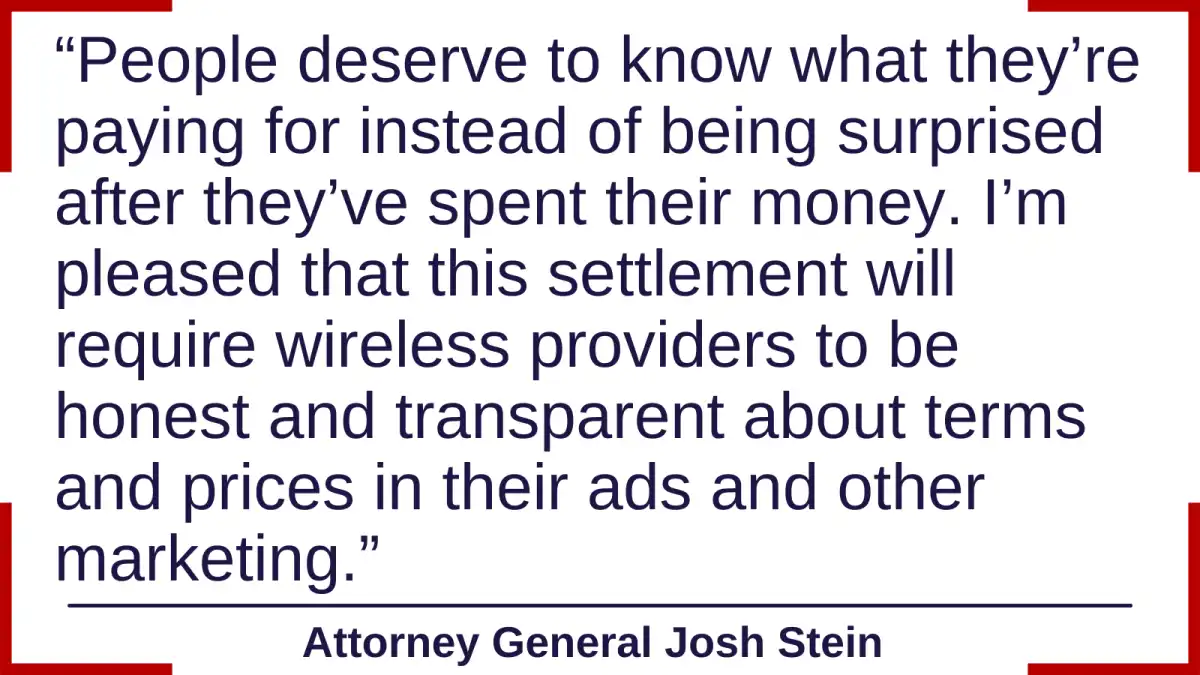
Attorney General Josh Stein stated that people deserve to know what they are paying for instead of being surprised after they have spent their money. He expressed satisfaction that the settlement will require wireless providers to be honest and transparent about terms and prices in their ads and other marketing.
Key Facts
- A porn site ad scam involved software creating hidden pages and forcing user clicks to generate fake traffic.
- AT&T and Verizon were among the companies that paid for hidden ads in the porn site scam.
- AT&T, Verizon, T-Mobile, Cricket Wireless LLC, and TracFone Wireless Inc. reached a $10.25 million multi-state settlement over deceptive advertising practices.
- The advertising investigation, launched in 2016, focused on misleading claims regarding "unlimited" data, free phones, and switching incentives.
- The settlement requires carriers to be truthful and accurate in future ads, disclose limitations, and train customer service representatives.