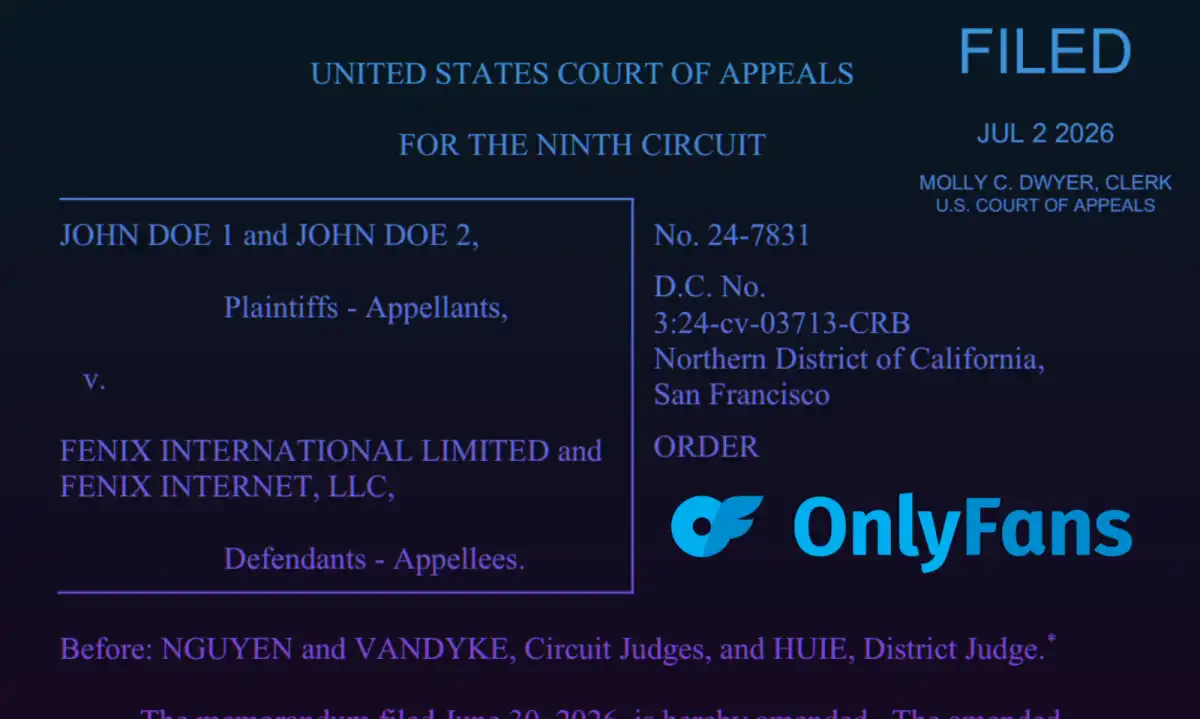
The U.S. Ninth Circuit Court of Appeals has revived a lawsuit against Fenix International Limited, the parent company of OnlyFans.com, concerning alleged violations of California's automatic renewal law. This decision reverses a prior dismissal by a federal district court, allowing the case to proceed.
Appellate Court Reinstates Auto-Renewal Claims
On June 30, a panel of three judges on the U.S. Ninth Circuit Court of Appeals issued an unpublished memorandum disposition, reversing and remanding a federal district court's dismissal of a putative class action complaint. The lawsuit, filed by two John Doe plaintiffs, alleges that Fenix International Limited, which operates OnlyFans.com, violated a California law regulating auto-renewing subscription services.
The federal district court had initially dismissed the complaint in April 2025, citing a lack of personal jurisdiction over Fenix's conduct in California. U.S. District Judge Charles R. Breyer of the Northern District of California ruled that because Fenix is headquartered in London, United Kingdom, there was no jurisdiction.
However, the appellate judges disagreed, stating, "We conclude that Plaintiffs established that Fenix expressly aimed its conduct at California." The ruling further noted, "Fenix’s arguments that it did not aim any conduct at California ignore that it regularly fulfills users’ subscriptions wherever those users access its online content, including California." Consequently, the Ninth Circuit vacated the district court's conclusion and remanded the case for further proceedings, effectively reviving the lawsuit.
The suing parties, identified as two consumers, raised issues with the functionality of recurring payments and subscriptions on the OnlyFans platform. The plaintiffs allege that OnlyFans failed to establish a clear user experience to obtain "the consumer's affirmative consent to the agreement containing automatic renewal terms."
California Automatic Renewal Law at Issue
The lawsuit centers on alleged violations of the California Automatic Renewal Law (CARL), which was incorporated into the state's unfair competition law. This amendment to the unfair competition law was reported in September 2024.
CARL mandates that businesses offering subscriptions, free trials, and recurring payments for digital services and products must secure "explicit affirmative consent" from users. Additionally, these businesses must provide "clear disclosures" detailing how users can easily cancel digital services. The law directly impacts adult websites that utilize recurring subscription models.
The complaint alleges that OnlyFans.com illegally enrolls consumers into automatically renewing memberships without providing "clear and conspicuous" disclosures or obtaining affirmative consent. It claims that consumers are not adequately informed during the sign-up process that their subscription for a content creator’s page will automatically renew, or that it may cost more than initially agreed. The lawsuit also states that at no point in the process is the consumer prominently or clearly informed of OnlyFans.com’s cancellation policy and process, as required by CARL.
If the CARL claims are upheld, Fenix and the content creators using OnlyFans could face a new subscription framework. Compliance interventions required by CARL include adopting transparent billing and subscription procedures, ensuring users are fully informed to grant express consent, and notifying users of fee changes or other alterations to user agreements or subscription conditions. The law also requires that user experiences for renewals and cancellations be simplified and intuitive, making subscription cancellation simple and effective.
Potential Impact on the Creator Economy
The revival of this case means it will return to Judge Breyer's court for further consideration on personal jurisdiction. The advancement of this lawsuit could have significant implications for the broader creator economy built around the OnlyFans.com ecosystem and its competitor platforms.
OnlyFans subscribers on June 9, 2026, urged the Ninth Circuit to revive the proposed class action, arguing that California courts have jurisdiction over Fenix International Limited because it auto-renews thousands of subscriptions in California and generates $400 million from the state annually.
The lawsuit, identified as Gates v. Fenix Internet LLC d/b/a OnlyFans.com, a Delaware limited liability company, was filed on May 13, 2025. The complaint is 12 pages long.
Key Facts
- The U.S. Ninth Circuit Court of Appeals revived a lawsuit against Fenix International Limited, parent company of OnlyFans.com, on June 30.
- The lawsuit alleges violations of California's Automatic Renewal Law (CARL) regarding auto-renewing subscriptions.
- The appellate court reversed a federal district court's April 2025 dismissal, which cited a lack of personal jurisdiction over London-headquartered Fenix.
- The Ninth Circuit ruled that Fenix "expressly aimed its conduct at California" by fulfilling user subscriptions in the state.
- Plaintiffs, two John Doe consumers, claim OnlyFans failed to obtain "explicit affirmative consent" and provide "clear disclosures" for auto-renewals.
- CARL requires transparent billing, express consent, notification of fee changes, and simplified cancellation processes for digital subscriptions.