
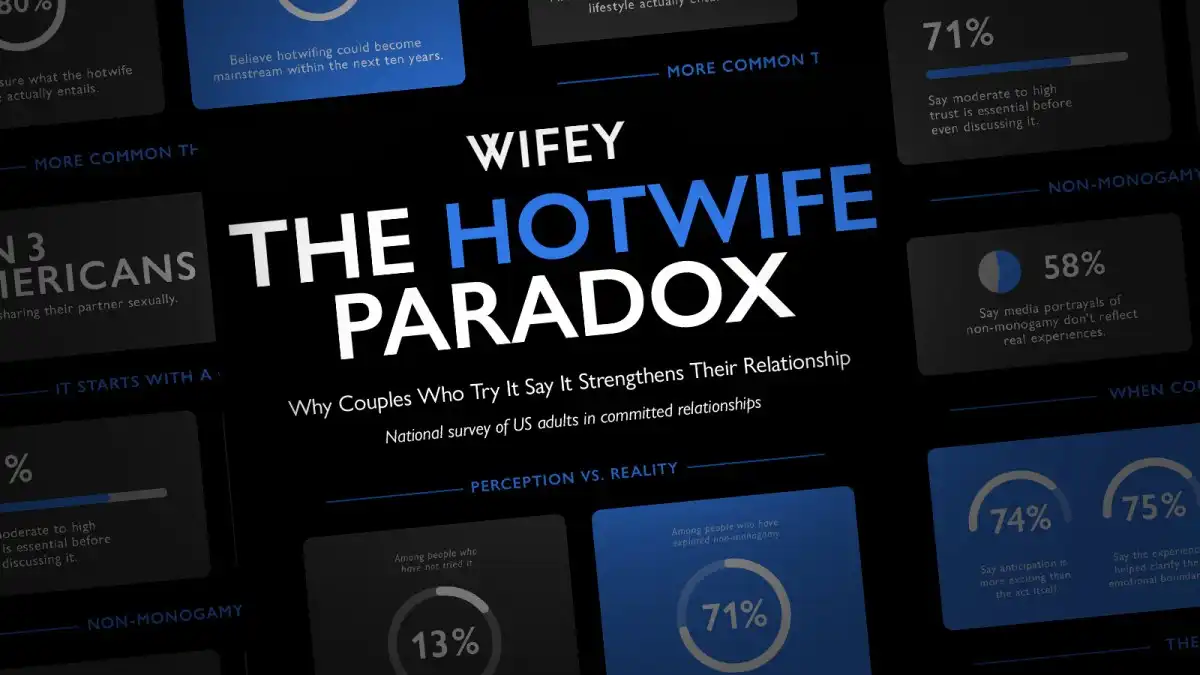
A new report by Vixen Media Group's WIFEY brand has revealed a significant disconnect between how Americans imagine non-traditional relationships and how they are experienced by those who practice them. The study found that 71% of couples who have explored consensual non-monogamy, including the hotwife dynamic, say it strengthened their relationship.
The Hotwife Paradox
The report, titled "The Hotwife Paradox," highlights a wide gap between how the lifestyle is imagined from the outside and how it is actually experienced by couples who approach it intentionally. In practice, hotwifing is a form of consensual non-monogamy in which a woman in a committed relationship engages sexually with another partner with her partner's knowledge and encouragement, as part of a shared fantasy.
The study was conducted by independent research agency TrendCandy in December 2025 through a national survey of U.S. adults aged 18 and older who are currently in committed relationships. The results show that while 71% of couples who have explored the lifestyle say it fortified their emotional bond, a mere 13% of the general population believes such a practice could have a positive effect.
Communication as the Core
The paradox lies in a fundamental misunderstanding of the practice. The term "hotwifing" is often conflated with cheating, but it is actually predicated on a foundation of intense communication, mutual respect, and meticulously negotiated boundaries. According to Dr. Tara, a certified sexologist, what stands out in this data is not risk-taking, but intention.
Couples who explore consensual non-monogamy successfully tend to over communicate. They spend more time discussing boundaries, emotions, and expectations than many traditionally monogamous couples do. This level of emotional literacy is often what strengthens the relationship, not the sexual dynamic itself.
A Quiet Shift in Modern Relationships
The study suggests that many couples are quietly rethinking what commitment looks like behind closed doors. They are finding that honesty, not secrecy, may be the key to deeper intimacy. While often assumed to be fringe or taboo, curiosity around partner sharing is more common than many realize.
Nearly one in three Americans (31%) say they've imagined sharing their partner sexually, and 40% believe it could be a way to reclaim excitement in a long-term relationship. However, nearly 80% of respondents admit they aren't fully sure what hotwifing actually entails, helping explain why it's frequently confused with cheating rather than understood as a form of consensual non-monogamy built on communication and trust.
Key Facts
- 71% of couples who have explored consensual non-monogamy say it strengthened their relationship.
- 13% of Americans in committed relationships believe the practice could have a positive effect.
- Nearly one in three Americans (31%) say they've imagined sharing their partner sexually.
- 40% of respondents believe hotwifing could be a way to reclaim excitement in a long-term relationship.
- Nearly 80% of respondents admit they aren't fully sure what hotwifing actually entails.