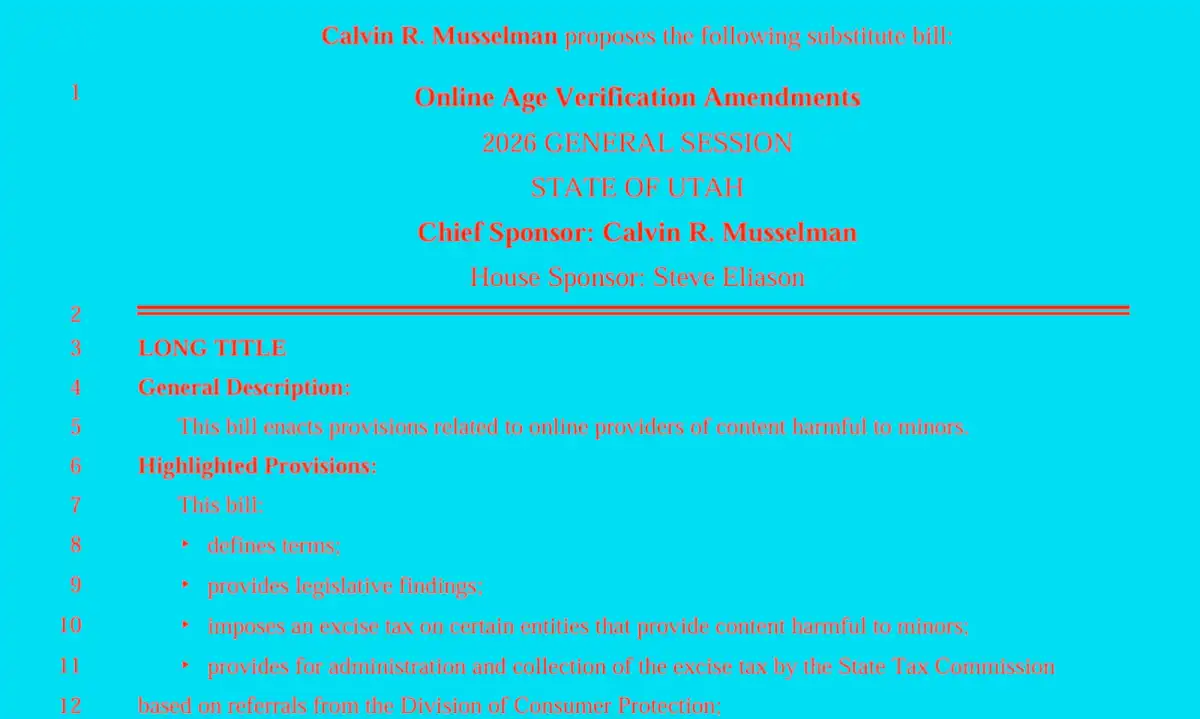

Pennsylvania state lawmakers are considering a proposed age verification law, Senate Bill (SB) 603, which explicitly targets adult entertainment websites to protect minors from age-restricted content. The bill, if adopted, would require state residents to provide proof of age, such as a state-issued identification card, when accessing websites where at least one-third of the material consists of adult content.
Legislative Movement and Sponsorship
The Pennsylvania Senate Judiciary Committee voted earlier this week to advance SB 603 with limited bipartisan backing, according to a Monday report by the Pennsylvania Capital-Star. Republican state Sen. Cris Dush of Jefferson is the bill's lead sponsor. Sen. Dush has presented the bill as a measure to hold large technology companies accountable. During the Monday committee hearing, Sen. Dush stated that the only current verification measure for adult content is clicking a button indicating one is 18 years old, and questioned why children should not be protected from pornography websites in the same way they are protected from online gambling.
If signed into law by Pennsylvania Gov. Josh Shapiro, a Democrat, SB 603 would classify a "reasonable age verification method" as any means of verification "through an independent, third-party age verification service that compares the personal information entered by the individual who is seeking access to the material that is available from a commercially available database or aggregate of databases that is regularly used by government agencies and businesses for age and identity verification." The legislation currently needs to be considered by the entire Senate before it can advance further. Previous attempts to implement age verification in Pennsylvania have not succeeded due to similar complaints regarding civil liberties and privacy rights.
Industry and Civil Liberties Opposition
Stakeholders and civil society groups, including the American Civil Liberties Union (ACLU) of Pennsylvania, have expressed opposition to SB 603, citing concerns about censorship and data privacy. Sen. Maria Collett, a Democrat representing Montgomery, was one of two lawmakers on the Senate Judiciary Committee to vote against the bill. While she supported the sentiment of the legislation, Sen. Collett identified the bill's lack of specifics for data privacy protections as a red flag. She noted that with the proliferation of cameras and constant online presence, personal data is increasingly not one's own.
Mike Stabile, director of public policy for the Free Speech Coalition (FSC), an adult industry trade association, echoed sentiments similar to those of Sen. Collett and other opponents. Stabile stated that the FSC has been engaged in Pennsylvania to educate lawmakers on device-based solutions. He suggested that the last-minute vote on Monday on a previously stalled bill appeared to be more about election-year politics than actual policy. Stabile confirmed that the FSC is working with allies in Pennsylvania and beyond to oppose this and other legislation deemed ineffective and dangerous.
Lawrence Walters, an attorney representing adult industry clients, views the Pennsylvania bill as problematic. Walters noted that similar bills adopted in other states feature severe private rights of action. SB 603 includes a "bounty" provision, similar to those seen in states such as Utah. This bounty law would require enforcement through a private right of action, subjecting every website covered by the bill and found in violation to scrutiny from parties like parents. Walters described SB 603 as another age-gating bill presented as child protection, arguing that it forces adults to provide private personal data to access lawful speech, which he considers a First Amendment problem. He added that the private right of action exacerbates the bill's issues, predicting that over-blocking would be the rational response from sites facing potential "bounty-hunter litigation." Walters suggested that if lawmakers want to assist parents, they should fund filters and enforce existing laws against dissemination to minors, rather than conscripting every adult site into an identification system.
Corey Silverstein, another attorney representing adult industry clients, expressed alarm regarding the potential harm of attempting to protect minors at the expense of free speech. Silverstein stated that the adult industry has consistently affirmed that protecting minors from inappropriate content is a legitimate and important objective. He posed the question of whether a particular law achieves that objective without unduly burdening adults' access to constitutionally protected expression or creating unacceptable privacy and data-security risks. Silverstein characterized SB 603 as another example of the increasingly fragmented state-by-state regulatory environment that online adult businesses are compelled to navigate.
Key Facts
- Pennsylvania Senate Bill (SB) 603 proposes requiring age verification for adult entertainment websites.
- The bill advanced through the Senate Judiciary Committee with limited bipartisan support.
- Republican state Sen. Cris Dush is the lead sponsor, advocating for the protection of minors.
- Opponents, including the ACLU of Pennsylvania and the Free Speech Coalition, cite concerns about censorship, data privacy, and First Amendment rights.
- SB 603 includes a "bounty" provision, establishing a private right of action for enforcement.
- Previous attempts at age verification legislation in Pennsylvania have failed due to similar civil liberties and privacy concerns.